Showing posts with label Defense. Show all posts

Wednesday, May 14, 2014

Tackling Progression Part III

In Part II, we discussed the Finish Phase in detail and added in a progression to use as well as video of the drills against air and with bags. Part I detailed how we use the progression and how we identify the different phases of tackling.

Now, we will discuss the Strike Phase as well as Strike & Finish drills.

The Strike Phase begins as the defender starts to initiate contact with the ball carrier.

This phase incorporates an aggressive double uppercut action with the arms as well as rapid and forceful hip extension into the ball carrier.

We use five drills in the Strike Phase and start by teaching the rapid hip extension and then adding the double uppercut action. Finally, we will reteach the Hit Position (athletes who have been in our strength program are already well versed in this position) before we put the entire action together while standing.

I don't have video of all these drills against air, bags and partners, but you will just add someone in holding a bag for the Knee Strike and Strike drills. I think the Strike drill works best with a Pop-Up Bag that players can basically run through without having to add in the elements of the Finish Phase. The Superman and Superman Uppercut drills can be used without those bags on the ground, but the players are more likely to commit to selling out if they know they're landing on something comfy.

Oh Snap!

You need to install Silverlight to watch Hudl presentations.

Download Silverlight

Need help installing Silverlight? Click here.


Some key points for these drills...

1. Superman: I did a bad job of this when I introduced it last year, but the athletes should have their hands behind their back so they can really concentrate of forcefully extending their hips.
2. Superman Uppercut: This is where we add the arms and the double uppercut action
3. Knee Strike:  This is the same motion as Superman Uppercut, only now the players take a knee. I make them switch knees after every rep so we get even work on both sides.
4. Hit Position: Use a cadence to get athletes in the proper position. I lost the audio on the video here. We start with "Feet" and the athletes settle their feet hip distance apart. Next is "Arms" and the players stick their arms behind their back as far as possible. After that is "Sink" and the athletes sink into a half squat. The last cue is "Holsters" and the players will put their hands on their "gun holsters" by bending their elbows. Once we've mastered this by using a cadence, we will just tell the players "Hit" and they must quickly assume the Hit Position.
5. Strike: This is the drill that most closely resembles an actual tackle since we are standing and incorporating both the double uppercut and hip extension.

Once we progress through the Strike Phase, we will bring the Strike & Finish Phases together into one fluid (hopefully!) motion.


Oh Snap!

You need to install Silverlight to watch Hudl presentations.

Download Silverlight

Need help installing Silverlight? Click here.


The goal is for the fundamentals of each phase to start transitioning into multiple phases as we add them together. As you can tell in some of the video, there are a fair amount of players who are missing some important concepts of the Finish Phase. There are a handful of athletes who aren't doing a good job squeezing their elbows together in the Clamp and many aren't putting their eyes to the sky as well.

Part IV will detail the Pursuit Phase, which consists of the Profile and Buzz tackles and include a document for our strict progression over the spring and summer.

Thursday, May 1, 2014

Tackling Progression Part II

In Part 1 of my tackling progression series, I detailed why and how I came up with a progressive system to teach tackling.

This next part encompasses how I teach the fundamentals of tackling through a progression of drills, starting with those in the Finish Phase.

As with all drills we teach, we want to go from simple and planned to complex and reactive. Doing simple and planned drills will allow all participants to gain confidence and develop the necessary skills to complete the drills that are complex later on.

Nearly every drill in the progression can be done on air, against a bag or with a partner.

In our section in California, we have "Spring Football" during the month of May. We're limited in hours per week, but we also can't use any equipment except a football. So, we start our tackling progression on air during May, beginning with the Finish Phase and ending with the Pursuit Phase.

Once June hits and we are in summer mode, our section allows us to use all equipment except for helmets, shoulder pads and leg pads. Now, we will use bags (shields) and go back through the entire progression.

When we go to our own team camp in Lake Tahoe and are in full pads for the first time, we will do our first live contact partner drills based on the progression. We will not go back through the entire progression, but hit the main concepts in a circuit instead.

After finishing camp I will evaluate where we need to begin reteaching tackling during the start of fall practice. Every year is different. We also gain players during the fall who weren't around during spring or summer football, so they must be instructed from the beginning.

FINISH PHASE DRILLS

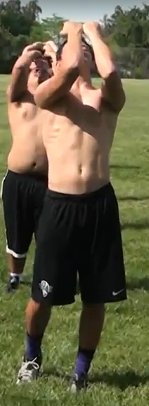
The first drill we introduce is the "Clamp". Players start with their feet hip width apart and slightly staggered. Their hips should be fully extended and I use the term "Shamu" to get them to make a small arch in their lower back similar to this a killer whale explosively jumping out of the water.


The defender's hands are above his head with closed fists grabbing cloth (pinkies together). Players should squeeze their elbows together and focus their eyes to the sky.

We teach this fundamental with coaches roaming around a giant layout of players so everyone can go at one time. Coaches correct on the fly.


Next, we add the fundamental of driving the legs through the tackle. The next drills are "Clamp & Slow Drive" and "Clamp & Fast Drive".

Players need to pull the "ball carrier" into their body and drive their knees high and wide during the Drive portion of these drills.

Often, players will forget some of the Clamp fundamentals once the Drive fundamentals are added. I've noticed that the biggest problem with players usually involves them not squeezing their elbows together while forming the Clamp.

Check out the Hudl Presentation with video of all three drills.


Oh Snap!

You need to install Silverlight to watch Hudl presentations.

Download Silverlight

Need help installing Silverlight? Click here.

Sunday, April 6, 2014

Tackling Progression Part I

Me in 2011: "You can't teach tackling. Either the players want to do it or they don't"

Me in 2014: "2011 me was an idiot."


When I first started coordinating I didn't have a progressive system to teach tackling to players. I had drills, a ton of them, but their was only a semblance of some type of purpose to them.

I didn't teach fundamentals well enough, I didn't keep my vocabulary consistent and when we were bad at tackling (and in 2011, we were terrible),  I didn't have a system in place to correct my players.

Following the 2011 season, I knew we had to improve, so I started looking into ways I could create a progressive system to teach tackling. By the start of our practices for the 2012 season, I had bits and pieces, but had yet to create the system I wanted.

Last spring I began chronicling the progression through the use of a PowerPoint presentation and started to take video of our drills.

My goal was to create a progression we could use program wide and refer to consistently from the freshman level on up to the varsity level.

None of this is original in thought... I "borrowed" most of it from a PowerPoint that steelhawk put up on Coach Huey first. Then, I listened to Coach Tim Murphy speak at a Glazier Presentation, watched some USA Football "Heads Up Tackling" videos, watched Bobby Hosea videos, reviewed tape of how Chris Ash teaches tackling, and continued to get other resources on Coach Huey. I just rearranged and changed some things to fit my liking and my situation.

We start by introducing the 3 phases of a tackle going from the position a player finishes a tackle in to how he starts a tackle.

1. Finish Phase
2. Strike Phase
3. Pursuit Phase

The Finish Phase includes the fundamentals of Clamp and Drive. Clamp is the act of holding onto a ball carrier with one's arms. Drive is the act of pumping one's legs and driving their hips through the ball carrier.

FINISH PHASE
The Strike Phase includes the fundamentals of the hit position, the violent double uppercut action of the arms and the popping of the hips and chest through the ball carrier.

STRIKE PHASE

The Pursuit Phase includes the two types of tackles a player sees during the course of the game: Profile and Buzz.

A Profile tackle occurs when a ball carrier is moving horizontally away from the defender and you can only see his "profile".

PROFILE TACKLE
A Buzz tackles occurs when a ball carrier is coming head on with a tackler and has a two-way go.

BUZZ TACKLE
Part II of this series will include video of some of the drills we use to practice these fundamentals as well as the progression it's completed in.


Friday, April 12, 2013

How to play with pressed CBs in Cover 4


I had the chance to listen to Michigan State Defensive Back Coach Harlon Barnett speak at the 2013 AFCA Convention.

Prior to the clinic, I had heard about the Spartans' use of pressed cornerbacks in their version of Cover 4. I was hesitant to give that version a shot because it seemed as if it would further isolate my corners, and it would also be difficult to play our version of 2-Read coverage.

After hearing Coach Barnett speak, I opened my mind a little bit and might use some pressed corner looks this summer.

Here's some notes from the nearly hour long lecture...

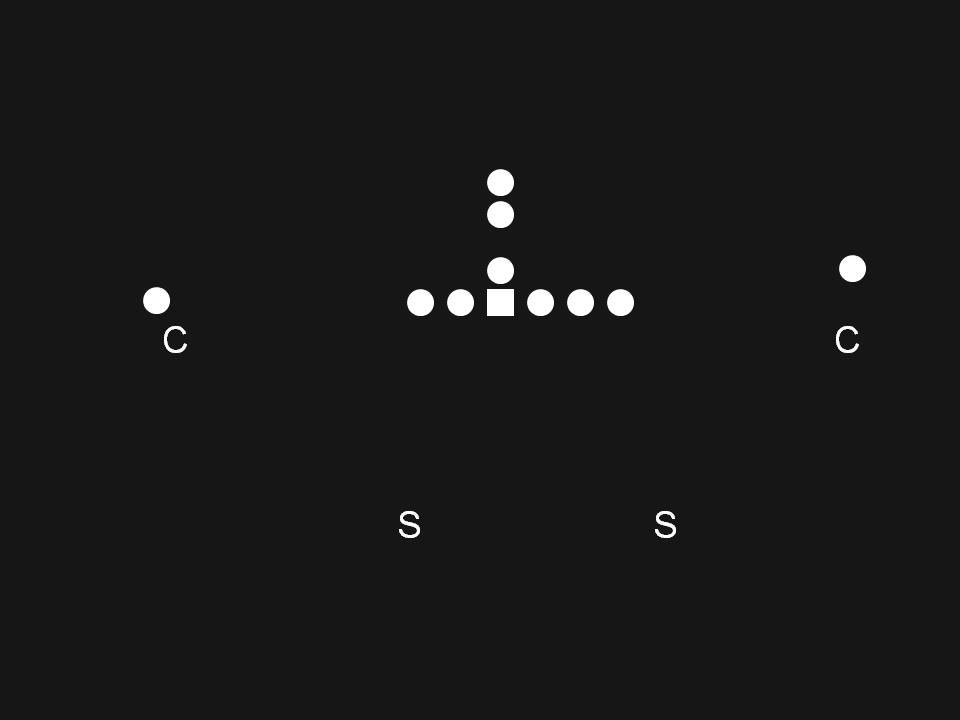
VS. PRO I


Key Points
- CBs line up 2-3 yards inside #1 WR
- If #1 WR is inside the divider, the CB lines head up
- Safeties line up 1x9 outside of the End Man on Line of Scrimmage
- Safety on weak side makes "MOD" call, which means "Man on Demand" or stay in man
- Safety on strong side makes "Box" call. The safety will take #2 man-to-man on any route over 10 yards. If #2 is not vertical past 10 yards, he will find the QB and play the football.
- The CB on the strong side has #1 on any route over 5 yards. On any route under 5 yards, he zones off his 1/4.
- If #2 is a TE or RB, you step downhill on the snap
- Eye control: Safety keys #2  (w/ no TE, key guard)
- Backside Safety has cutback (creates 9-man front)

VS. EMPTY


- To the 3 WR side, the Spartans play "Midpoints". The CB splits #1 and #2 at 8 yards and plays the ball. The S splits #2 and #3 and plays the ball. The safety will key #3 and lean towards him on any vertical route. Basically, they are playing Cover 3 to this side.
- To the 2 WR side, Michigan State can play a ton of calls... Read (2-Read), Box, Cloud, Dog (2-Man)
- If hurt by quick game, play man

VS. TRIPS


- Weak side CB plays "MOD"
- Weak side safety is in a B-10 alignment (B gap at 10 yards).
- Weak side safety makes a "Yo-Yo" call, which means he will take #3 on the any vertical route.
- Can play any coverage call to the #1 and #2 WR to the strong side.
- Strong side safety is 1x10 off the #2 WR, not the ball.

General notes
- Using a pressed corner forces the WR to be predictable when running routes
- Using a pressed corner forces the WR to bubble his release which messes up timing
- Using a pressed corner takes away the easy quick game, which is one of the pitfalls of Cover 4
- Safeties use a slightly staggered stance with inside foot up. Inside foot should move first.
- Press: Off-hand jam aiming for near pec
- CBs read WR hips through "Move" area (0-18 yards)
- CB needs to cutoff and control after the "Move" area. CB needs to keep running.
- CBs will use an outside alignment in "Read" (2-Read) unless the WR is outside the divider

Thursday, April 4, 2013

Defending 11's Personnel with the 4-2-5

One question that consistently gets asked on CoachHuey.com and one I get a fair amount of questions on is how to line up or defend 11's personnel with the 4-2-5.

The greatest asset of the 4-2-5 is its flexibility and that comes in handy when defending 11's personnel.

In my eyes, there are three basic 11's personnel formations you will see:

#1. Pro Ace
#2. Pro Trips Ace
#3. Pro Trey Ace

Of course there are plenty of variations with receiver and back alignment, shotgun, pistol and other looks, but we'll stick with those three.

To simplify things, I will line up and play base defense in one of two ways:

#1. If I want to stop teams that run predominantly to the TE side, I will play an Under front and Cover 3.

#2. If I want to stop a strong passing attack, I will play an Over front and Cover 4.


Easy enough?

Let's assume we are in the middle of the field

We'll start with what I call Pro Ace.


We call our Over front "Tight", which tells our (M)ike LB to set the front strength to the TE side. Across the front, we are in a 6i, 3, 1 and 5. The (F)ree Safety will set the secondary strength to the passing strength, so he will make a "Right" call here. Both our F and (W)eak Safety will make a check to their side based on their rules. With a #2 detached to the free side, we make a "Read" call and play 2-Read. With 1-back and 1-WR to the weak side, we make a "Read" call and play 2-Read.


We call our Under front, "Split Tough". Split tells the M to set the front to the split end side (or away from the TE) and Tough tells our safeties to play 1x1 off the TE. Normally if our (H)ammer or weakside end gets a TE to his side, he gets in a 6i and makes a "G" call which tells the (N)ose to move from a 1 to a 2i. When we use our "Tough" call, the ($)trong Safety will tell the H "Tough", which tells him to stay in a 5 and cancel the "G" call.

When we play Cover 3, we set the secondary strength to the TE side when one is present. This allows us to put our $, who is usually the better run defender out of him and the W, to the TE side. He is usually a better player for us at playing on a TE as well. We play Cover 3 with similar rules to Saban's Rip/Liz, with some notable differences, but our $ and W will carry the vertical of #2 until #1 comes shallow. Our F splits the #2's (here, the TE and slot WR) and plays high hole.

Moving on to Pro Trips Ace...


We use automatic trips checks for different formations. I won't signal in that we are going to play Special Sky, we will just game plan it that way. I just signal in we are playing Cover 4 here. Again, we are in an Over front and the F is setting the secondary strength to the 3 WR side. We run Special by playing man-to-man on #3 and playing 2-Read to #2 and #1. On the weak side, we play Sky.


Again, when we play Cover 3, we will set the secondary strength to the TE and our F will adjust if he needs to. We are in "Split Tough" (Under) up. Our F is now taking the vertical of #3 to #2, the W is carrying #2 vertical and our (C)orner has the vertical of #1.

Tuesday, February 12, 2013

2012 in Review: Cover 0 Blitzes

Our defense bases out of zone coverage.

When we want to bring pressure, we do so predominantly out of Cover 3. But, we also have a Cover 0 package as well.

Our Cover 0 pressures are categorized two ways: Bomb (Linebackers) and Bullets (Safeties).

When we run Cover 0, we do so to effect the quarterback in the passing game and to bring additional defenders to the party in the run game. It's also a pretty common short-yardage call for us.

In our Bomb blitzes, our Cornerbacks take #1 man-to-man, our free safety takes #2 to the passing strength man-to-man, our weak safety takes #2 to the away side man-to-man (or the back out his way in 2-back). Our strong safety takes the running back (or the back to the passing strength in 2-back).


We ran 23 bomb blitzes over the course of 11 games this season and gave up only 47 yards (2.04 average), and added an interception and two sacks.  On the flip side though, we gave up seven touchdowns.

So, what do these numbers mean?

Well, at first glance, it would seem that our Bombs were go big or go home plays. Further digging revealed that six of the touchdowns were given up inside the 10-yard line. The only score we gave up outside of the 10-yard line was a 20-yard pass for a TD on a first down.

In our Bullets blitzes, we send both safeties against two back sets. When the offense presents a one-back formation, our weak safety will make a you/me call to the LB on his side and that LB will replace him on the blitz while the weak safety takes #2 man-to-man. Otherwise, every other defender does exactly as he does in the Bombs.


When we ran our 18 Bullets blitzes last season, we allowed 3.83 yards per play and three total touchdowns while forcing a fumble and collecting two sacks. Two of the three touchdowns came inside the 10-yard line and the biggest play we gave up was 32 yards on a 4th and 7.


Looking at the numbers would make it seem like we had a fair amount of success blitzing out of Cover 0. We may look to use those blitzes in more than just short-yardage and goal line situations and use them on early downs as well. Cover 0 doesn't play into my normal, bend, but don't break philosophy, but I also like to get out of my tendencies when I can.

A lot will ride on how good our secondary can play man-to-man against some of the more athletic teams we see throughout our league schedule.

Any thoughts on trends/stats that I'm missing or not seeing through the correct lens?

Monday, November 26, 2012

Looking back...2012 in Review


"Reflection is the better part of a champion"
I took a major break from this blog as things got hectic with our spring and summer program and didn't even think about it during our actual football season.
It feels good to be back and have an outlet to reflect upon this year.
This season was a step in the right direction for our football program. We made the playoffs for the first time since 2009, beat our cross-town rivals for the first time in five years and won seven games, something that hasn’t happened at our school since 2002.
Unfortunately, we ran into a solid program in the first round of the playoffs and fell 49-19.
Last season we went 2-8 following a 4-6 showing in 2010. Those were both very long years. This season flew by. We had a lot of fun along the way and although I didn’t always take time to enjoy the voyage, I’ve been able to reflect upon the success we had now that the season is over.
It was truly a remarkable trip. This year’s seniors had won a combined five football games their first three years of high school football. Those who stuck it out showed tremendous resolve. And they were rewarded for their hard work.
This year was my fourth as Defensive Coordinator and fifth overall coaching high school football. Our defense had a remarkable turnaround from the previous season. Last year we had major issues tackling and giving up big plays. It showed as we allowed our opponent’s to score over 37 points per game.
This group of seniors was our first who learned our offensive and defensive schemes as freshman and ran it for four years in the program. I think that definitely attributed to our success this season. Although we lacked some size and speed defensively we made up for it by understanding our alignment and assignment and then executing our jobs at a high rate. Our players deserve a ton of credit for how football smart they are and for how well they retained what was taught to them throughout their career.
As some of you know, we run a 4-2-5 that blends itself between multiple styles. We base out of Cover 4, but we also run Cover 3, zone blitz and run Cover 0 blitzes. We use an Over front that can be set anywhere we want and get into an Under front against 21 personnel  teams.
We are multiple, but simple at the same time. Regardless of what exact call we are in, I want my players to know where to line up, who their key is and how they react to that key. I want them playing fast.
This season our defense made a tremendous turnaround from the previous one. In 2011, we couldn’t stop teams from running on us, gave up over 37 points per game and were the worst tackling team I had ever been around.
This year, we gave up 20.63 points per game and allowed 50 yards less per game (255) than we did last season.
I always look at 3rd-down conversion percentage as a tell-tale sign of whether or not a defense is any good. The ability to get off the field when given the chance is key to success. Our goal for every game is to hold our opponents to 30% or less on 3rd down conversions. This season we held our opponents to 28% on 3rd down, a 10% improvement!
We forced 25 takeaways (12 interceptions and 13 fumbles), six more than last year and increased our sack total by eight.
All this was accomplished with only one full-time returning starter in our front seven. The strength of our defense was definitely our safeties and corners, three of whom were starters last year. Two of them earned 1st-team All League status at defensive back and a third earned 1st-team honors offensively.
I didn’t do a whole lot differently than any previous season. But, I did make a switch and coach the defensive backs. The previous three seasons I had been the linebackers coach. I was lucky enough to have our previous JV Head Coach move up and assist with the LBs and our defensive line coach did a tremendous job as always.
We did use a different approach to introduce tackling fundamentals and I felt like we did a better job correcting fundamental tackling mistakes during practice.
This season and the talent we have coming up in our program has given us a very positive outlook on the next couple of years. This year’s team laid the foundation for this program to build for years to come.


*In future entries, I will continue to reflect on the 2012 season, but in more detail in regards to our schemes, other areas of our program, what went right, what went wrong, etc.

Saturday, April 14, 2012

Creating a Pass Rush Mentality on the Defensive Line


I had the pleasure of listening to Tosh Lupoi, Defensive Line Coach at the University of Washington, speak at a Glazier Clinic earlier this year.
His presentaton was impressive. He really changed my mindset for how to mentally prepare defensive linemen on every snap.

He puts his guys into three different modes depending on what they are trying to accomplish. Stances, alignments and the thought process changes in each mode.

Base Mode

Whenever the defensive linemen aren't expecting to rush the passer and they are not stunting, they are in base mode. Their stance must be balanced and powerful in order to react to the different types of blocks they see.

They should have their eyes on the blocker they are reacting to and their hand off their leg. If they happen to  rush the passer out of base mode and they get engaged by an offensive lineman, they should attempt to use a push/pull move or long-arm (basically a violent punch that separates them from the offensive lineman) the blocker.

Stunt Mode


Lupoi didn't go much into what they do exactly in stunt mode due to time restrictions, but I would assume the stance would complement where they plan on moving towards without giving away where they are going. The stance doesn't need to be as balanced as in base mode and the defensive linemen should have a pre-determined plan for how they are going to attack the gap they are stunting to. Their eyes should be on the ball.
Jet Mode


This is the mode defensive linemen need to get into for a pass rush emphasis. They should transition from a balanced stance to a speed or sprinter's stance with narrow feet, butt up in the air, head down and looking inside towards the ball. I have seen guys (most recently the Philadelphia Eagles' Jason Babin and Trent Cole and their notorious Wide 9 alignment) use a four-point stance when they are in this mode, but I would suggest doing whatever is most comfortable for you as a coach. I don't know which one was is better for this mode, but I'd be willing to let my players decide what is most comfortable for them.

Lupoi wants his guys to have great takeoff, so he emphasizes rolling and leaning out of their stance. It's the exact reason, the NFL makes guys come to a pause in their stance for one second before taking off when they time 40s at the combine.
In order to accomplish this though, they must understand the opponent's cadence. The DL should use a credit card alignment (you shouldn't be able to slip anything more than a credit card between the DL's head/hand then a credit card), loosen their width on alignment and get into a gap alignment instead of on a shade. When they takeoff out of their stance, the DL should replace their hand with their foot on their first step.
Mentally, the DL needs to have a plan. Their goal in Lupoi's mind is to effect the passer. They should have a move they want to attack the OL with and a counter in case it doesn't work.

In the end, Lupoi wants to coach violent, aggressive pursuit over anything else. While he teaches his guys "rush lanes", he preached not to over coach it while emphasizing that most QB scrambles through the interior first, not on the edge.

Making it Happen

You can tell your players you are going to use different modes, but unless you have a way to communicate this to them during the heat of battle, it's not going to matter much.

First, these modes should be drilled in practice. This needs to happen in individual periods first and then can transition into team periods later.

We will always be in base mode unless the DL has a stunt on, in which, surprise, they will be in Stunt mode!

You can have your players get into Jet Mode in one of three ways.
1. Yell a call out to them from the sideline
2. Have a player identify down and distance every play (this means you must teach your players what D&D you want them to be in Jet mode in)
3. Send in a Jet package (my preferred method), where you will have your four best pass rushing defensive linemen in the game regardless of size. You will only use this in obvious passing situations though. So, it's critical you know your opponent's run/pass tendencies based on D&D.
Some of you may have a hard enough time getting your freshmen DL into a normal 3-point stance, so I wouldn't suggest using this at lower levels. More advanced Varsity DL will be able to handle this transition though. If nothing else, create a pass rushing mentality and let your DL loose on obvious passing situations.


Friday, January 27, 2012

Book Review: Complete Linebacking


Sometimes I forget just how much better (and cheaper!) books are than DVDs. Although it helps to see live video of drills, Complete Linebacking by Lou Tepper is the most in-depth look at a position I've ever seen compiled in one place.

Tepper, who was most recently the Head Coach at Indiana University of Pennsylvania and was recently canned despite a 36-18 record was also the Head Coach previously at Illinois and the defensive coordinator during a disastrous time at LSU.

This proves again that there are more good coaches than good teams. Tepper knows what he is talking about and it shows in this book. He is general enough that coaches can apply what they learn to any defense, but he does dive into the specifics of linebacker technique in certain defenses.

The book begins with Tepper describing the physical and mental qualities he looks for in a linebacker. He goes a step further by comparing those with actual players he has coached.

Tepper does an excellent job breaking down the fundamentals for linebackers, starting with what he calls the "Hit and Shed" base. He follows his explanations up with numerous drills that reinforce each idea. The diagrams are well done and pretty easy to follow.

He also discusses what his linebackers do during the time between plays. This is something I would have skipped out on in a position manual.

The worst part about the book is when Tepper refers to Jerry Sandusky when discussing a drill he learned from him. Just hearing his name gives me the creeps.

This is a must read for any defensive coordinator or linebackers coach. It has helped me craft and organize my linebacker position manual a little better and opened my eyes to teaching some fundamentals in a new way.

Monday, January 9, 2012

Video Review: Defensive Back Play From A-Z


I've often wondered whether DVD's from companies like Coaches Choice or Championship Productions were worth the cost.

In the past, I have been disappointed with some of the videos I have purchased. They were either too simple, didn't fit what I was trying to do or the situation I was in or they were just an outright rip-off.

With that said, I will be reviewing any videos I buy in the future, both to rehash what I learned and to give everyone else some insight before they pony up their hard earned cash.

One of my main goals this off-season was to retool our defensive back play, including our fundamentals and drills. After soliciting the services of the CoachHuey message board, I was pointed towards the Coaches Choice videos authored by Nick Rapone.
When the DVD's were made, Rapone was a DBs coach at Temple. He is currently the Defensive Coordinator for the University of Delaware.

This video is actually a set of six different ones CoachRapone has made. I had a 50% off holiday coupon code and I used a digital download, so I actually paid about $38 for six DVDs! That is cheaper than you can normally buy one video for! Needless to say, I was pretty proud of myself when I purchased them.

The six videos last just over 3 hours and 30 minutes and cover The Art and Practice of Tackling, Off-Man and Catch-Pass Coverage Techniques, Individual Techniques for Defensive Back Play, Cover 2 Pass Defense, Championship Defensive Back Drills and Bracket and Vice Double Coverage Techniques . It took me a little while to watch all of them and I took meticulous notes while doing so (it's the only way I remember anything nowadays).

These were by far the best videos I have purchased to date. I would rate the series as a whole an 8/10. Coach Rapone does a great job breaking down the drills he uses and explains the purpose that they serve in his scheme. If there was one pitfall to the series, it was that many of the drills and fundamentals were repeated. The game film wasn't the best quality and it would have been beneficial to have them presented in a Hudl-like manner with arrows and circles so I could focus on what I needed to without having to rewind.

One thing that stuck out to me was how Coach Rapone taught how to break up a comeback route. If the DB is unable to "shoot the hip" and get in front of the wide receiver, he should not come over the top and create contact. Instead, he should go underneath the receiver's arms and separate them away from their body.

Coach Rapone talks in length about how to read a 3-step drop and how to react to different routes while breaking on the upfield shoulder. There are a ton of drills relating to man-to-man schemes, zone schemes and just simple fundamentals any DB would need.

There is a little bit of everything in this set, so if you're an aspiring DB coach, need to learn from the ground up or just want a refreshing look at how to coach DB play, these videos are more than worth the money.

*Note: I will continue to review some of the previous DVDs I have bought in further posts.