Monday, May 6, 2013

The Birthplace of the Pistol: 2013 Nevada Spring Game


While in Reno for the California State Athletic Director's Association yearly conference (yes, a state conference was held outside of the state), some of our coaching staff took the time to take in the Nevada spring game and get an up close and personal view of where the Pistol began.

Traditionally, we have been a flexbone, inside veer/midline team that also got into shotgun, predominantly to throw the ball. One problem we consistently ran into was a lack of a similar running game out of shotgun.

Now, we are going to begin infusing a Pistol look as our base backfield set. We will be able to keep the rest of the offense pretty similar, but will have to re-tool the mesh and steps for the QB, fullbacks and slotbacks.

Leading up to the game I read a fair amount of local newspaper articles and new Head Coach Brian Polian noted that they would be pretty vanilla on both sides of the ball as not to give anything away for their opening game.

Nevada used 11's personnel and this look A LOT!


Some quick things I took from the Wolf Pack Spring Game:

#1 - Nevada lived in 11's (1-back, 1-TE) personnel. They moved their H-back/TE around a lot pre snap with different motions and he was always on the move post snap, crossing the formation to kick out a DE or lead up on a LB.
#2 - Different plays looked extremely similar from a big picture standpoint. This constantly put the DE's in conflict. Nevada primarily ran inside zone, Power and a Power Read.

Count the numbers... How do you not run some sort of option football?

#3 - Their biggest play was consistently the Power Read. especially when their athletic QB pulled the ball and got to the perimeter.
#4 - Offensive linemen splits differed throughout the game. I'm sure this is an adaptation to the play call. The guard-to-center split varied from about one to three feet and the guard-to-tackle split varied from about two to three feet.
#5 - I was impressed with how well the defense tackled throughout the game. They were extremely effective in open field situations.

Friday, April 12, 2013

How to play with pressed CBs in Cover 4


I had the chance to listen to Michigan State Defensive Back Coach Harlon Barnett speak at the 2013 AFCA Convention.

Prior to the clinic, I had heard about the Spartans' use of pressed cornerbacks in their version of Cover 4. I was hesitant to give that version a shot because it seemed as if it would further isolate my corners, and it would also be difficult to play our version of 2-Read coverage.

After hearing Coach Barnett speak, I opened my mind a little bit and might use some pressed corner looks this summer.

Here's some notes from the nearly hour long lecture...

VS. PRO I


Key Points
- CBs line up 2-3 yards inside #1 WR
- If #1 WR is inside the divider, the CB lines head up
- Safeties line up 1x9 outside of the End Man on Line of Scrimmage
- Safety on weak side makes "MOD" call, which means "Man on Demand" or stay in man
- Safety on strong side makes "Box" call. The safety will take #2 man-to-man on any route over 10 yards. If #2 is not vertical past 10 yards, he will find the QB and play the football.
- The CB on the strong side has #1 on any route over 5 yards. On any route under 5 yards, he zones off his 1/4.
- If #2 is a TE or RB, you step downhill on the snap
- Eye control: Safety keys #2  (w/ no TE, key guard)
- Backside Safety has cutback (creates 9-man front)

VS. EMPTY


- To the 3 WR side, the Spartans play "Midpoints". The CB splits #1 and #2 at 8 yards and plays the ball. The S splits #2 and #3 and plays the ball. The safety will key #3 and lean towards him on any vertical route. Basically, they are playing Cover 3 to this side.
- To the 2 WR side, Michigan State can play a ton of calls... Read (2-Read), Box, Cloud, Dog (2-Man)
- If hurt by quick game, play man

VS. TRIPS


- Weak side CB plays "MOD"
- Weak side safety is in a B-10 alignment (B gap at 10 yards).
- Weak side safety makes a "Yo-Yo" call, which means he will take #3 on the any vertical route.
- Can play any coverage call to the #1 and #2 WR to the strong side.
- Strong side safety is 1x10 off the #2 WR, not the ball.

General notes
- Using a pressed corner forces the WR to be predictable when running routes
- Using a pressed corner forces the WR to bubble his release which messes up timing
- Using a pressed corner takes away the easy quick game, which is one of the pitfalls of Cover 4
- Safeties use a slightly staggered stance with inside foot up. Inside foot should move first.
- Press: Off-hand jam aiming for near pec
- CBs read WR hips through "Move" area (0-18 yards)
- CB needs to cutoff and control after the "Move" area. CB needs to keep running.
- CBs will use an outside alignment in "Read" (2-Read) unless the WR is outside the divider

Thursday, April 4, 2013

Defending 11's Personnel with the 4-2-5

One question that consistently gets asked on CoachHuey.com and one I get a fair amount of questions on is how to line up or defend 11's personnel with the 4-2-5.

The greatest asset of the 4-2-5 is its flexibility and that comes in handy when defending 11's personnel.

In my eyes, there are three basic 11's personnel formations you will see:

#1. Pro Ace
#2. Pro Trips Ace
#3. Pro Trey Ace

Of course there are plenty of variations with receiver and back alignment, shotgun, pistol and other looks, but we'll stick with those three.

To simplify things, I will line up and play base defense in one of two ways:

#1. If I want to stop teams that run predominantly to the TE side, I will play an Under front and Cover 3.

#2. If I want to stop a strong passing attack, I will play an Over front and Cover 4.


Easy enough?

Let's assume we are in the middle of the field

We'll start with what I call Pro Ace.


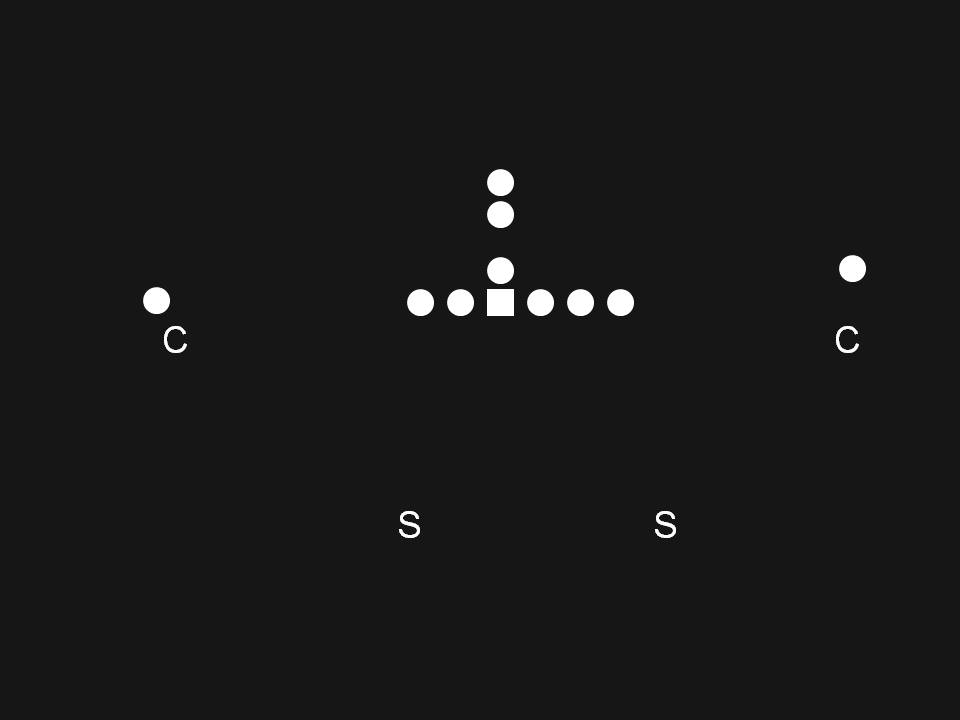
We call our Over front "Tight", which tells our (M)ike LB to set the front strength to the TE side. Across the front, we are in a 6i, 3, 1 and 5. The (F)ree Safety will set the secondary strength to the passing strength, so he will make a "Right" call here. Both our F and (W)eak Safety will make a check to their side based on their rules. With a #2 detached to the free side, we make a "Read" call and play 2-Read. With 1-back and 1-WR to the weak side, we make a "Read" call and play 2-Read.


We call our Under front, "Split Tough". Split tells the M to set the front to the split end side (or away from the TE) and Tough tells our safeties to play 1x1 off the TE. Normally if our (H)ammer or weakside end gets a TE to his side, he gets in a 6i and makes a "G" call which tells the (N)ose to move from a 1 to a 2i. When we use our "Tough" call, the ($)trong Safety will tell the H "Tough", which tells him to stay in a 5 and cancel the "G" call.

When we play Cover 3, we set the secondary strength to the TE side when one is present. This allows us to put our $, who is usually the better run defender out of him and the W, to the TE side. He is usually a better player for us at playing on a TE as well. We play Cover 3 with similar rules to Saban's Rip/Liz, with some notable differences, but our $ and W will carry the vertical of #2 until #1 comes shallow. Our F splits the #2's (here, the TE and slot WR) and plays high hole.

Moving on to Pro Trips Ace...


We use automatic trips checks for different formations. I won't signal in that we are going to play Special Sky, we will just game plan it that way. I just signal in we are playing Cover 4 here. Again, we are in an Over front and the F is setting the secondary strength to the 3 WR side. We run Special by playing man-to-man on #3 and playing 2-Read to #2 and #1. On the weak side, we play Sky.


Again, when we play Cover 3, we will set the secondary strength to the TE and our F will adjust if he needs to. We are in "Split Tough" (Under) up. Our F is now taking the vertical of #3 to #2, the W is carrying #2 vertical and our (C)orner has the vertical of #1.

Tuesday, February 12, 2013

2012 in Review: Cover 0 Blitzes

Our defense bases out of zone coverage.

When we want to bring pressure, we do so predominantly out of Cover 3. But, we also have a Cover 0 package as well.

Our Cover 0 pressures are categorized two ways: Bomb (Linebackers) and Bullets (Safeties).

When we run Cover 0, we do so to effect the quarterback in the passing game and to bring additional defenders to the party in the run game. It's also a pretty common short-yardage call for us.

In our Bomb blitzes, our Cornerbacks take #1 man-to-man, our free safety takes #2 to the passing strength man-to-man, our weak safety takes #2 to the away side man-to-man (or the back out his way in 2-back). Our strong safety takes the running back (or the back to the passing strength in 2-back).


We ran 23 bomb blitzes over the course of 11 games this season and gave up only 47 yards (2.04 average), and added an interception and two sacks.  On the flip side though, we gave up seven touchdowns.

So, what do these numbers mean?

Well, at first glance, it would seem that our Bombs were go big or go home plays. Further digging revealed that six of the touchdowns were given up inside the 10-yard line. The only score we gave up outside of the 10-yard line was a 20-yard pass for a TD on a first down.

In our Bullets blitzes, we send both safeties against two back sets. When the offense presents a one-back formation, our weak safety will make a you/me call to the LB on his side and that LB will replace him on the blitz while the weak safety takes #2 man-to-man. Otherwise, every other defender does exactly as he does in the Bombs.


When we ran our 18 Bullets blitzes last season, we allowed 3.83 yards per play and three total touchdowns while forcing a fumble and collecting two sacks. Two of the three touchdowns came inside the 10-yard line and the biggest play we gave up was 32 yards on a 4th and 7.


Looking at the numbers would make it seem like we had a fair amount of success blitzing out of Cover 0. We may look to use those blitzes in more than just short-yardage and goal line situations and use them on early downs as well. Cover 0 doesn't play into my normal, bend, but don't break philosophy, but I also like to get out of my tendencies when I can.

A lot will ride on how good our secondary can play man-to-man against some of the more athletic teams we see throughout our league schedule.

Any thoughts on trends/stats that I'm missing or not seeing through the correct lens?

Friday, November 30, 2012

2012 in Review: Shield Punt


During last off-season I spent a lot of time studying different punt schemes. One which continued to catch my eye was the “Shield Punt”.  A ton of college programs were using it and I had previously read an article about it in one of the American Football Coaches Association publications. I also solicited input from the Coach Huey community and thought I had been convinced to move forward with my plans.
Still, I found myself doubting its effectiveness. We had been punting from a spread formation and were a half man, half zone protection unit. That punt scheme was something I felt extremely comfortable with and knew inside-out. But, we continued to have issues getting downfield and covering kicks and teaching the protection scheme was not economical. Our number one issue was that we had trouble getting downfield and covering kicks. We are not the type of team that is going to be successful in space against some of the athletic teams we face in our league.
Knowing this, I decided to make the leap and change our scheme last summer. I planned out the necessary details and drills and moved ahead with a plan to install our version of the Shield Punt.
Boy, were we happy we did!
Our big boys loved being the heart of the punt team!
We attempted 31 punts this season. Our punter averaged 31.4 yards per attempt and we downed six kicks inside the 20-yard line including one that died on the one-yard line. Out of those 31 punts, opponents didn’t even attempt to field the kick 20 times!
Think about that! Two-thirds of our punts were not even returnable. We didn’t have to attempt to make a tackle on 67% of our punts!
This is because the Shield Punt releases defenders into lanes right away and high school returners  (and some coaches for that matter) don’t want to touch a ball if they’re in a crowd for fear of muffing the kick.
Out of the other 11 punts, six were fair caught (including five alone in our playoff game). We only had to make a tackle in space five times throughout the season! That was my main goal with this unit.
Our opponents averaged only two return yards when we punted (giving us a net of 29.4 yards per punt), with most coming on a 50-yard return that we missed some easy tackles and probably out-kicked our coverage on.
Another reason I initially shied away from the Shield Punt was that I viewed its basic formation as difficult from which to run a fake from.
I love running fakes on special teams. I enjoy taking advantage of schematic disadvantages most special teams units put themselves in and love the momentum-grabbing effect that a converted fourth-down on special teams can have on an offense.
Our spread punt left the door open to run whatever type of fake we wanted to. This new Shield Punt seemed like it wouldn’t fit that mold. It was the last hurdle I had to clear mentally before diving in head first.
Last season, in our spread punt, we were 3-for-4 for 78 yards and three converted first downs when we faked a punt.
After some careful studying and a lot of doodling I found a handful of fakes I thought would work well with the Shield Punt. They turned out to be a success this year. We were 2-of-3 for 18 yards and two first downs on fakes. The one we didn’t convert was a bad, emotional call from me. We didn’t have the numbers advantage we normally look for. I just felt like we could catch them off guard and get it.
On top of all that we also forced opponents into four penalties for 50 yards, two of which were roughing the kicker calls, while only committing one penalty for five yards ourselves.
All in all, we only lost five yards throughout the entire season on punt when you tally punt return yardage, our fake yardage and penalty yardage on both sides. That's way better than where we had been in year's past.

Check out some clips below. The last two are fakes we ran successfully this  season.

Oh Snap!

You need to install Silverlight to watch Hudl presentations.

Download Silverlight

Need help installing Silverlight? Click here.


Most weeks we found that teams didn't know how to scheme their punt return or block. Most teams didn't rush or attempt to set up a return. If they did, it wasn't executed well. 

One issue we had throughout the season was our front line guys bowing back. Although we never got called for not having enough men on the line of scrimmage, we were warned twice by refs.

We need to get better at blocking at the guard and tackle positions. This season, I didn't coach them up well enough and as such there first steps were off and we lost ground sometimes.
I will continue to fine tune this unit in the off-season, but I am now completely sold on the Shield Punt.

Monday, November 26, 2012

Looking back...2012 in Review


"Reflection is the better part of a champion"
I took a major break from this blog as things got hectic with our spring and summer program and didn't even think about it during our actual football season.
It feels good to be back and have an outlet to reflect upon this year.
This season was a step in the right direction for our football program. We made the playoffs for the first time since 2009, beat our cross-town rivals for the first time in five years and won seven games, something that hasn’t happened at our school since 2002.
Unfortunately, we ran into a solid program in the first round of the playoffs and fell 49-19.
Last season we went 2-8 following a 4-6 showing in 2010. Those were both very long years. This season flew by. We had a lot of fun along the way and although I didn’t always take time to enjoy the voyage, I’ve been able to reflect upon the success we had now that the season is over.
It was truly a remarkable trip. This year’s seniors had won a combined five football games their first three years of high school football. Those who stuck it out showed tremendous resolve. And they were rewarded for their hard work.
This year was my fourth as Defensive Coordinator and fifth overall coaching high school football. Our defense had a remarkable turnaround from the previous season. Last year we had major issues tackling and giving up big plays. It showed as we allowed our opponent’s to score over 37 points per game.
This group of seniors was our first who learned our offensive and defensive schemes as freshman and ran it for four years in the program. I think that definitely attributed to our success this season. Although we lacked some size and speed defensively we made up for it by understanding our alignment and assignment and then executing our jobs at a high rate. Our players deserve a ton of credit for how football smart they are and for how well they retained what was taught to them throughout their career.
As some of you know, we run a 4-2-5 that blends itself between multiple styles. We base out of Cover 4, but we also run Cover 3, zone blitz and run Cover 0 blitzes. We use an Over front that can be set anywhere we want and get into an Under front against 21 personnel  teams.
We are multiple, but simple at the same time. Regardless of what exact call we are in, I want my players to know where to line up, who their key is and how they react to that key. I want them playing fast.
This season our defense made a tremendous turnaround from the previous one. In 2011, we couldn’t stop teams from running on us, gave up over 37 points per game and were the worst tackling team I had ever been around.
This year, we gave up 20.63 points per game and allowed 50 yards less per game (255) than we did last season.
I always look at 3rd-down conversion percentage as a tell-tale sign of whether or not a defense is any good. The ability to get off the field when given the chance is key to success. Our goal for every game is to hold our opponents to 30% or less on 3rd down conversions. This season we held our opponents to 28% on 3rd down, a 10% improvement!
We forced 25 takeaways (12 interceptions and 13 fumbles), six more than last year and increased our sack total by eight.
All this was accomplished with only one full-time returning starter in our front seven. The strength of our defense was definitely our safeties and corners, three of whom were starters last year. Two of them earned 1st-team All League status at defensive back and a third earned 1st-team honors offensively.
I didn’t do a whole lot differently than any previous season. But, I did make a switch and coach the defensive backs. The previous three seasons I had been the linebackers coach. I was lucky enough to have our previous JV Head Coach move up and assist with the LBs and our defensive line coach did a tremendous job as always.
We did use a different approach to introduce tackling fundamentals and I felt like we did a better job correcting fundamental tackling mistakes during practice.
This season and the talent we have coming up in our program has given us a very positive outlook on the next couple of years. This year’s team laid the foundation for this program to build for years to come.


*In future entries, I will continue to reflect on the 2012 season, but in more detail in regards to our schemes, other areas of our program, what went right, what went wrong, etc.

Saturday, April 14, 2012

Creating a Pass Rush Mentality on the Defensive Line


I had the pleasure of listening to Tosh Lupoi, Defensive Line Coach at the University of Washington, speak at a Glazier Clinic earlier this year.
His presentaton was impressive. He really changed my mindset for how to mentally prepare defensive linemen on every snap.

He puts his guys into three different modes depending on what they are trying to accomplish. Stances, alignments and the thought process changes in each mode.

Base Mode

Whenever the defensive linemen aren't expecting to rush the passer and they are not stunting, they are in base mode. Their stance must be balanced and powerful in order to react to the different types of blocks they see.

They should have their eyes on the blocker they are reacting to and their hand off their leg. If they happen to  rush the passer out of base mode and they get engaged by an offensive lineman, they should attempt to use a push/pull move or long-arm (basically a violent punch that separates them from the offensive lineman) the blocker.

Stunt Mode


Lupoi didn't go much into what they do exactly in stunt mode due to time restrictions, but I would assume the stance would complement where they plan on moving towards without giving away where they are going. The stance doesn't need to be as balanced as in base mode and the defensive linemen should have a pre-determined plan for how they are going to attack the gap they are stunting to. Their eyes should be on the ball.
Jet Mode


This is the mode defensive linemen need to get into for a pass rush emphasis. They should transition from a balanced stance to a speed or sprinter's stance with narrow feet, butt up in the air, head down and looking inside towards the ball. I have seen guys (most recently the Philadelphia Eagles' Jason Babin and Trent Cole and their notorious Wide 9 alignment) use a four-point stance when they are in this mode, but I would suggest doing whatever is most comfortable for you as a coach. I don't know which one was is better for this mode, but I'd be willing to let my players decide what is most comfortable for them.

Lupoi wants his guys to have great takeoff, so he emphasizes rolling and leaning out of their stance. It's the exact reason, the NFL makes guys come to a pause in their stance for one second before taking off when they time 40s at the combine.
In order to accomplish this though, they must understand the opponent's cadence. The DL should use a credit card alignment (you shouldn't be able to slip anything more than a credit card between the DL's head/hand then a credit card), loosen their width on alignment and get into a gap alignment instead of on a shade. When they takeoff out of their stance, the DL should replace their hand with their foot on their first step.
Mentally, the DL needs to have a plan. Their goal in Lupoi's mind is to effect the passer. They should have a move they want to attack the OL with and a counter in case it doesn't work.

In the end, Lupoi wants to coach violent, aggressive pursuit over anything else. While he teaches his guys "rush lanes", he preached not to over coach it while emphasizing that most QB scrambles through the interior first, not on the edge.

Making it Happen

You can tell your players you are going to use different modes, but unless you have a way to communicate this to them during the heat of battle, it's not going to matter much.

First, these modes should be drilled in practice. This needs to happen in individual periods first and then can transition into team periods later.

We will always be in base mode unless the DL has a stunt on, in which, surprise, they will be in Stunt mode!

You can have your players get into Jet Mode in one of three ways.
1. Yell a call out to them from the sideline
2. Have a player identify down and distance every play (this means you must teach your players what D&D you want them to be in Jet mode in)
3. Send in a Jet package (my preferred method), where you will have your four best pass rushing defensive linemen in the game regardless of size. You will only use this in obvious passing situations though. So, it's critical you know your opponent's run/pass tendencies based on D&D.
Some of you may have a hard enough time getting your freshmen DL into a normal 3-point stance, so I wouldn't suggest using this at lower levels. More advanced Varsity DL will be able to handle this transition though. If nothing else, create a pass rushing mentality and let your DL loose on obvious passing situations.